BY: DIGITAL WAX MEDIA STAFF
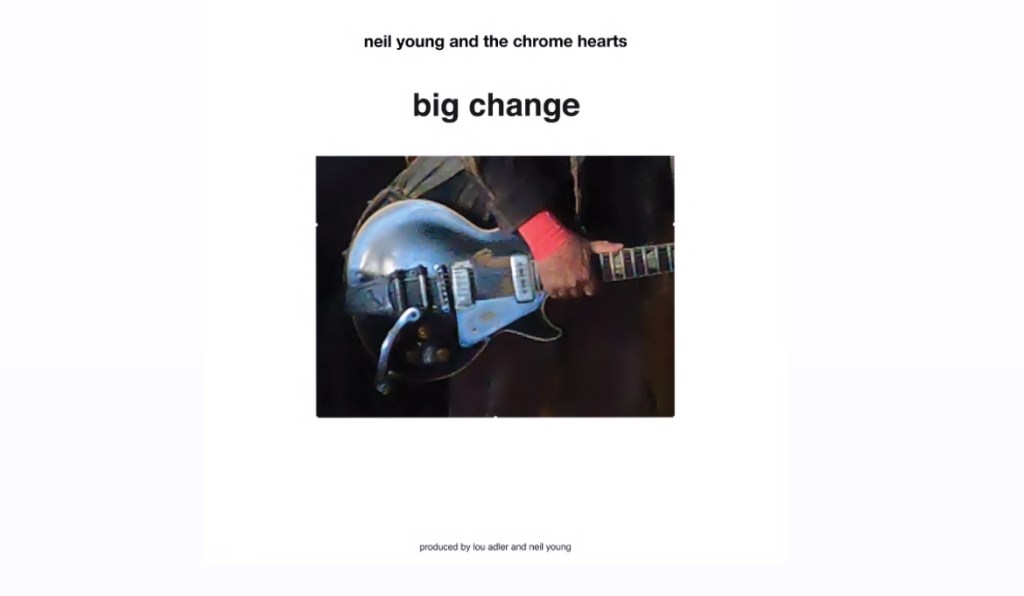
Big change is coming – so rings the promise of one of the most distinctive artistic voices in rock, Neil Young. The irreverent songwriter has delivered a new single with his latest backing unit, the chrome hearts, ahead of a brand new album in collaboration with the group. Young himself occupies his usual position as lead vocalist and guitarist while the chrome hearts provide support in the form of bassist/vocalist Corey McCormick, drummer Anthony LoGerto, and organist/vocalist Spooner Oldham.
The gnarly number offers the first taste of new material from an upcoming album which was reportedly recorded at breakneck speed during an unexpected marathon songwriting session by Young. With all font for marketing materials released in conjunction with “big change” stylizing proper nouns in lowercase, one could assume that this may hint at a larger overarching concept with regard to its parent project. Ever the prolific songsmith, Young will log yet another LP in what currently sits at a staggering 44-album studio discography. For those keeping track, that’s an average of one full-length album release every 1.25 years, or an album roughly every 15 months).
These statistics of course do not factor in the upcoming release of Ocean Countryside, a recently announced “lost album” said to have been recorded by Young in mid-to-late 1977. The recordings are expected to be released digitally and through limited edition vinyl pressings on Valentine’s Day, 2025.
As for “big change,” the single opens to a squeal of feedback before launching into a characteristically abrasive barrage of sound. Amidst an enveloping wash of cymbals and guitars, it can be difficult to discern precisely what is what at any given time with regard to the arrangement. But one can only assume that this is by design – Neil Young isn’t an artist known for placing much value in trivialities such as overthinking a song’s harmonic structure or ensuring that each instrument has its own neat and tidy space within the mix. Engineer John Hanlon compared the song to the work of abstract expressionist painter Jackson Pollack, who himself was renowned for his unconventional approach to creation which often made intentional use of unpredictable elements and techniques.
The verse sections of “big change” follows a looping D-C-Bm chord progression, though the song’s intro falls right in on the C. The progression of the intro’s root notes (C-B-D) recreates a note sequence with the intro chords of the Grateful Dead’s take on the folk number, “Morning Dew.” Though in the case of the Dead, the B note acts as the third of a G major chord rather than the root of a B minor chord. It’s an interesting coincidence which reinforces a vague sense of impending doom inherent within the sonics of Uncle Neil’s latest.
The title does much to clue the listener in on the subject matter of “big change,” as the phrase is repeated no fewer than sixteen times over the course of the song’s two-minute and fifty-four-second runtime. The big change in question is presented as a foregone conclusion, though it is never specified just what it entails, just that it, “could be bad and it could be good,” or even “great.”
Much is likely to be made of the timing of the release, which comes just days before the official start of the next United States presidential administration. One would be justified in assigning a political interpretation to the song, which thunders forward like the unwavering march of some colossal force on an odyssey to nowhere in particular.
Though declarations from politicians are specifically mentioned in “big change,” the lyrics don’t necessarily feels as much like a warning of big change in the year 2025 as much as a reiterating of the inescapable inevitability of oncoming change at any and all times throughout life. Much like Neil Young himself as an artist, all things are in a perpetual state of flux always.
“It might be your decision, now you’ve got to see it through,” Young sings. Indeed, our circumstances are often of our own design, and one is generally better served embracing the reality of even the most negative of situations with a tenacity and stoicism detached from the circumstance from which it emerged.
Neil Young and the chrome hearts’ “big change” is available to stream now.

 Digital Wax