BY DIGITAL WAX MEDIA STAFF
During the late-1990s, professional wrestling hit a level of commercial popularity and cultural significance that may be difficult for those who weren’t present to witness the phenomenon firsthand to wrap their heads around.
The World Wrestling Federation (WWF – later to become WWE) and World Championship Wrestling (WCW) were locked in an ongoing battle for supremacy, and the weekly spectacle of dramatics and increasingly absurd displays of violence kept viewers glued to their seats.
Coinciding with this development was the advent of video games as a standard form of entertainment and fairly common addition to the average home. Found in the center of the Venn Diagram featuring professional wrestling fans and adamant gamers was a dedicated base of buyers who lived for weekends during which their friends could sleep over and partake in bouts of cartoon brutalization by any one of the wrestling game titles made available at the time. The following is a non-comprehensive assortment of such titles, some of which may even warrant revisiting today.
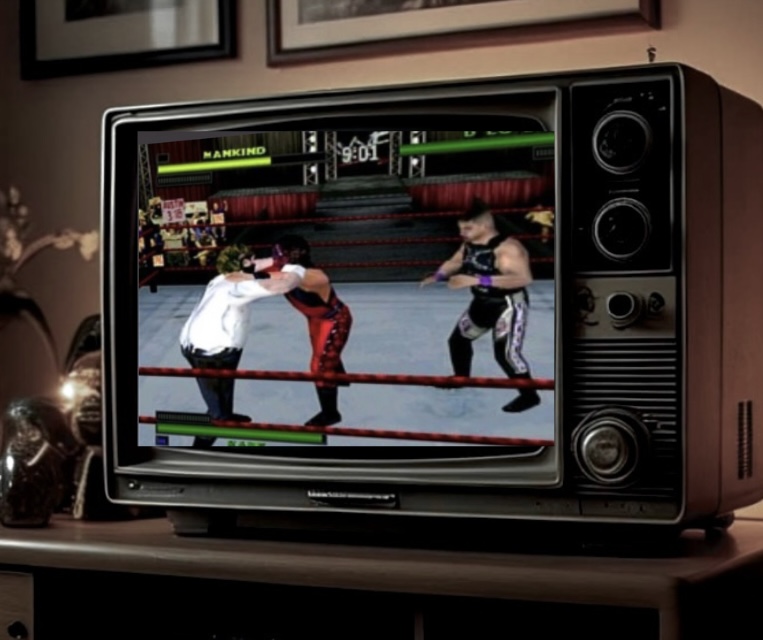
– WWF Warzone –

The divisive title released for PlayStation, Nintendo 64, and Game Boy has received retroactive criticism for its graphics and gameplay, but marked a fairly substantial step forward in wrestling gaming at the time of its 1998 release. Founding IGN editor Matt Casanassina even called it “the best looking wrestling game ever made” upon release.
Boasting a roster featuring key Attitude Era figures such as “Stone Cold” Steve Austin, Mankind, and Bret “The Hitman” Hart – the latter of whom had actually jumped ship for WCW half a year prior to the game’s release – Warzone gave players the opportunity to fully embody their favorite WWF superstars.
Despite its relatively primitive nature by comparison to more recent WWE titles, Warzone may have featured the best in-game commentary of any release from the company. True to the era in which it was released, the game features incredibly well executed commentary from the classic team of Vince McMcMahon himself and Good Ol’ J.R – Jim Ross. We’re talking long before the days of the conniving Mr. McMahon character, who would go on to become an occasional competitor himself, even earning heavyweight gold on two separate occasions.
Options for Cage and Weapons style matches, along with an expansive “Create Player” mode, made for an exhilarating gaming experience for 90s kids blissfully unaware of the technological innovations to come.
– WWF Attitude –

WWF Warzone was followed up by WWF Attitude in 1999 for PlayStation and Nintendo 64. Attitude came with a wealth of surface-level features such as an extensive roster of superstars, full wrestler ring entrances, Pay-Per-View mode, and customizable arena options.
PlayStation and Nintendo 64. Attitude came with a wealth of surface-level features such as an extensive roster of superstars, full wrestler ring entrances, Pay-Per-View mode, and customizable arena options.
The title afforded enough flash to keep fans engaged, but the gameplay itself – largely retained from its predecessor, WWF Warzone – still left much to be desired in terms of maneuverability, leaving many players frustrated at the actual wrestling aspect of the title.
Like Warzone before it, WWF Attitude featured in-game commentary from real on-screen personalities, this time in the form of wrestling legend and color commentator Jerry “The King” Lawler and future in-ring competitor, behind-the-scenes personality, and chairman’s son, Shane McMahon.
A key element of WWF Attitude was the options for customization it offered players. From sussing out the smallest details for arena location to customizable wrestling stables, Attitude afforded players a level of freedom with which they weren’t accustomed to at the time.
The cherry on top, as it were, came in the form of legitimate voiceovers for the in-game characters recorded by the WWF superstars themselves, which contributed to a sense of authenticity in the gameplay.
– WCW/NWO Revenge –
Featuring heavy-hitters such as Sting, Goldberg, and Diamond Dallas Page as part of its sixty-plus playable character lineup, WCW/NWO Revenge was larger-than-life in many of the same ways as its television counterpart which aired weekly.
The tried-and-true AKI grappling system is present in Revenge, making it fairly simple to pick up for those with experience utilizing the system in other titles. Changes both minor and major, including the addition of instant replays and the introduction of in-ring weaponry, render the game a commendable step up from its predecessor, WCW vs NWO World Tour.
The attention to detail evident in the game itself served as a treat for fans of the product back in 1998. From ring attire designs and idiosyncratic movements to a classic “Big Gold” World Heavyweight Championship belt being rendered in great detail – and featuring the iconic “NWO” spray paint, depending upon who is holding the title at a given time – make for exciting additions which kept many a millennial picking up the controller time and time again.
The presence of the NWO Wolfpack was much appreciated, and the thrill of the red & black duking it out with the classic black & white, as well as the traditional WCW roster, set a generation of imaginations on fire with inspiration.
“Story modes” as we know them today left something to be desired in the case of many pre-2000s titles, and Revenge could reasonably be categorized as one such title. The game does offer a “story mode”-adjacent experience through “Championship Mode.” This mode of gameplay sees players in single-player mode chasing after one of several championships as a chosen character. Available titles included US Heavyweight, Cruiserweight, World Heavyweight, Tag Team, and TV championships.
Though WCW/NWO Revenge is quite clearly dated by today’s gaming standards, the title was a milestone addition in the late-90s and served to push the envelope of gaming as it pertained to the massively popular world of professional wrestling. In this sense, Revenge can be seen as a No Mercy of sorts for the WCW brand, though it’s worth noting that WCW beat WWF to the punch on this one, as No Mercy wouldn’t see release until the year 2000. Speaking of which…
– WWF No Mercy –
The holy grail of wrestling games to this day, No Mercy not only delivered the wrestling game die-hards had long been waiting for, it also introduced legions of fans to professional wrestling and what would become the WWE product.
Released in 2000 as the follow up to Wrestlemania 2000 from the year prior, No Mercy went deep, affording players the capacity to partake in complex storylines based on actual WWF programming, as well as build and utilize custom characters with an extensive availability of design and move options.
Additionally, the grapple-based control system first introduced in Wrestlemania 2000 and utilized once more for No Mercy was a monumental step up from previous games issued by the company, and simplified gameplay substantially – but not to such an extent as to detract from the enjoyment of the experience.
Options for match types such as First Blood, Ladder, King of the Ring, and Royal Rumble offered hours of fun for players and their friends to pummel one another to pulps around the console on Saturday night.
With loads of unlockables, storylines, and match types for players to enjoy, along with four distinct attire options for each superstar, WWF No Mercy set the precedent for wrestling games, going on to become the third best-selling game of all time for the Nintendo 64 console.
– Wrestlemania x8 –
Wrestlemania x8 is a singular entry of sorts in the scope of the world of WWE gaming. Intended to jumpstart a Nintendo-based series in the same vein as the Smackdown! series for PlayStation, things never quite came together for the console-specific entries, not dissimilar to the fate of Raw series for Xbox.
Nonetheless, Wrestlemania x8 was overflowing with new characters and features, and upon release was like water in a drought to fans who had been returning to No Mercy for years and years as the WWF product continued to drift further and further from the universe represented through the N64 gameplay.
Significantly, Wrestlemania x8 featured the long awaited WWF video game debut of a slew of WCW and ECW superstars who were incorporated into WWF programming during the Invasion angle following the collapse of WCW. Some such superstars include Rob Van Dam, Booker-T, and the newly reestablished NWO stable featuring Scott Hall, Kevin Nash, and Hollywood Hulk Hogan.
Additionally, match types including Hell In a Cell, Ladder, Tables, TLC, Battle Royal, and Ironman were featured. The inclusion of Hell In a Cell was a treat to longtime fans who delighted in utilizing the structure to destroy opponents by tossing them into, off, and through the steel.
The advanced console of the Nintendo Gamecube – by comparison to the N64 – allowed for more realistic visuals, including legitimate titantron entrance videos and up-to-date (for the most part) licensed music – including Limp Bizkit’s “Rollin’” as the entry theme for The Undertaker.
While maintaining the grapple system, the controls for Wrestlemania x8 underwent some alterations, and the gameplay as a whole hasn’t aged all that well. Still, it remains favorable over the subsequent entry Wrestlemania 19, which while boasting many additions – including the ability to play as Goldberg – the story mode is a complete mess and the game itself seems to be pulling itself in too many directions at once.
–WWE Smackdown! Shut Your Mouth –
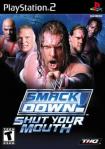
Smackdown! Shut Your Mouth is arguably the most revolutionary wrestling video game ever to be produced – this writer would place it comfortably behind No Mercy.
The very first wrestling game to be released under the “WWE” banner after the switch was made from “WWF,” Smackdown! Shut Your Mouth featured extensive graphical overhauls and impressive attention to detail.
The additions made for Wrestlemania x8 which delighted fans were seen here along with a litany of inclusions players didn’t even realize they’d needed. These included an absurdly flexible create-a-wrestler feature with allotted players complete control over the process.
A more engaged story mode along with the implementation of the WWE Brand Extension tied the product heavily to then-current programming and opened up options for building pay-per-views and setting up title angles. Several notable superstars make their WWE game debuts with Shut Your Mouth, including Brock Lesnar, Diamond Dallas Page, Billy Kidman, and Randy Orton.
Advanced realism in animation, movesets, and in-ring (and out-of-ring) capabilities brought about by technological developments and the gaming power of the PlayStation 2 console made WWE Smackdown! Shut Your Mouth a force to be reckoned with upon its release, and the game still holds up today.
What are some of your favorite classic wrestling video game titles?
All artwork and graphics used under Fair Use Editorial guidelines



 Digital Wax