BY: DIGITAL WAX MEDIA STAFF
The shortlist of bonafide guitar icons features a fairly standard assembly of names which get referenced by listeners and musicians who would come after. Classic rockers such as Eric Clapton, Jimi Hendrix, and Jimmy Page as well as pioneering players like B.B. King and Chuck Berry are the standard fare for these types of musical directories.
But there’s one name that, while often escaping the awareness of the standard listener, is often cited as having been a profound inspiration to many of the greatest players ever pick up a six-string. That name is Johnny “Guitar” Watson.
Born February 3, 1935, in Houston, Texas, John Watson Jr. set himself on what would become an immensely impactful musical trajectory before even reaching adulthood. He received his very first guitar from his grandmother at a young age, and was encouraged to pursue the instrument by his father.
“He was playing spiritual songs on the guitar when I got it,” Watson has been quoted as saying of his first instrument. “My grandmother told me not to play any blues on it – and that was the first thing I taught myself to play!”
Early in life Watson would bear witness to live performances from the likes of T-Bone Walker, Lightnin’ Hopkins, and Clarence ‘Gatemouth” Brown – the latter of whom made an impression on Watson by way of his lively, energizing stage show and visceral guitar playing. This would undoubtedly serve as an inspiration for the young guitarist, who would adopt many of these same characteristics into his own performance persona.
The young musician began making a living playing music as a teenager, performing vocals, guitar, and piano at various establishments and making his first recordings while still a teen. Watson initially performed under a version his government name, having been billed as “Young John Watson” into the early 1950s. But a viewing of the 1954 Nicholas Ray western film Johnny Guitar would serve as the inspiration for a change in stage name, leading Watson to adopt the full title of the film itself as part of the updated moniker: Johnny “Guitar” Watson.
It was this moniker which Watson would retain throughout the remainder of his career, and it was this name under which the musician would record the classic 1956 r&b/blues number, “Three Hours Past Midnight.” The song would have an enormous impact on subsequent performers over the ensuing decades, with composer and guitarist Frank Zappa going as far as to credit the tune with having inspired him to pickup his primary instrument in the first place.
There are several layers in terms of particular characteristics that made Johnny “Guitar” Watson the monumental musical force he undoubtedly was. Among these were the distinctive piercing tone of his guitar playing, achieved through a unique fingerpicking-style attack of the strings which Watson himself would refer to as “stressifying” the strings. He would bring this aggressive approach to an array of styles throughout his career, including the blues and r&b for which he initially gained recognition, and later in the soul and funk styles throughout which he would attain his peak success commercially decades later.
While Johnny “Guitar” Watson is recognized perhaps primarily for his work on his namesake instrument, the bluesman was also a skilled and expressive vocalist. The musician’s vocal stylings took a soulful, emotive approach, with Watson utilizing his voice just as much as an instrument in and of itself as his guitar.
Watson’s exuberant and bold persona were also part of what made Johnny “Guitar” Watson such a fantastic character in the overall history of music. His penchant for flashy clothing items and garish accessories gained the musician much attention, as did his brash and forthright personality.
Not dissimilar to fellow 1950s luminary Little Richard, Johnny “Guitar” Watson was very much ahead of the curve in terms of recognizing his own greatness and influence. Watson would famously note that he had been the first to implement many of the performative techniques for which guitarists like Jimi Hendrix would often be credited, such as playing the guitar using one’s teeth and other flamboyant on-stage behavior.
While propounding the scope of one’s own ability could be perceived as arrogant or uncouth, Watson would more or less be justified such assertions, particularly in the later years of his life and ensuing decades following his death. The notoriously dismissive and hypercritical Frank Zappa would cite Watson as a profound influence time and time again over the course of his own career.
Zappa would even get a chance to work with his hero in 1975 for the Mothers of Invention’s One Size Fits All album. Watson would provide additional vocals for the songs “San Ber’dino” and “Andy,” and would collaborate again with Zappa on subsequent albums including 1984’s Them or Us, 1985’s Thing-Fish, and 1985’s Frank Zappa Meets the Mothers of Prevention.
One of the most highly revered guitar players of all time, Stevie Ray Vaughan was also an adamant admirer of Watson’s work according to his brother Jimmie Vaughan, and accomplished blues guitarist and singer in his own right and a member of The Fabulous Thunderbirds. According to Vaughan, Johnny “Guitar” Watson was among but a handful of players who he and his brother held in very high regard. Other names to make this shortlist included Freddie King, B.B. King, and Albert King.
Additionally, highly influential acts such as Etta James, Bobby Womack, Steve Miller, and countless others have cited the unique approach of Watson as a critical influence.
Johnny “Guitar” Watson would go through many musical and artistic evolutions over the course of his nearly 45-year career, reinventing himself time and time again to make a new statement, to hit a new mark, and to climb a new mountain. In 1996, during the early portion of a concert performance in Yokohama, Japan, Watson would reportedly drop dead of a heart attack on stage. Fittingly, those close to the guitarist would later state that this is precisely the manner in which he had declared he wished for his life to end.
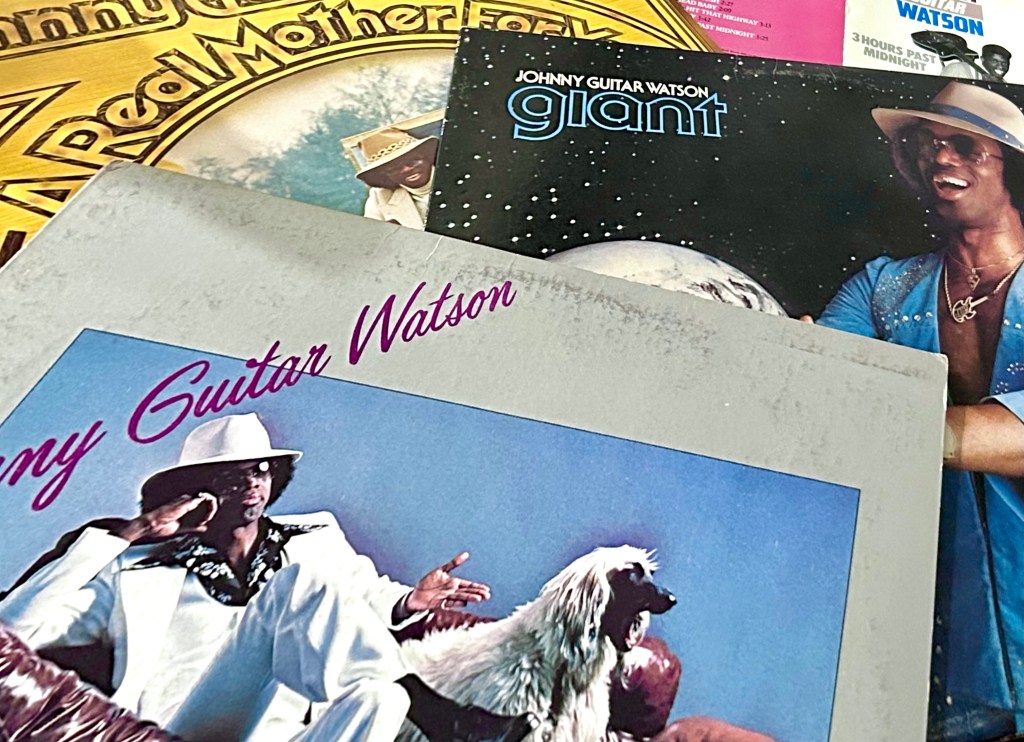
Though his may not be circulated in discussions of the “all-time greats” with the consistency of names like Jimi Hendrix, Eddie Van Halen, and Stevie Ray Vaughan, Johnny “Guitar” Watson – just as would be implied by his 1978 LP – was a musical giant who legacy and contributions to popular music as a whole stand forever cemented in the cultural lexicon.



 Digital Wax