BY: DIGITAL WAX MEDIA STAFF
In many ways, the Grateful Dead behind 1987’s In the Dark was a different unit entirely than the ragtag bunch out of Haight Asbury that established itself as an eclectic, exploratory sonic vehicle to a separate dimension. As a matter of fact, the same could be said of the band in each of its iterations, be it its jazz-tinged ‘73-‘74 period – designated the “turbocharged, turn-on-a-dime Grateful Dead” by late bass visionary and founding member Phil Lesh – the unfaltering, well-oiled machine late-‘70s era, or the hazy early ‘80s.
The fact is, the Grateful Dead would essentially become a different band altogether every few years, with the common thread running through the proceedings being the inherent looseness and extended jams that characterized all that the group would do.
Though the late-‘80s would provide a wealth of quality material in its own right, the 1986 coma suffered by guitarist, vocalist, and national treasure Jerry Garcia would ultimately serve as a clear diving point in the band’s history with regard to overall sound. Garcia would be required to reinvent himself as a vocalist and guitarist in the wake of the incident.
The Grateful Dead would achieve the greater extent of their commercial success under the leadership of this retooled Garcia – though Garcia himself would adamantly refute any accusations of “leadership.” Many listeners who would eventually become longtime fans would be introduced to a version of the band featuring this particular iteration of Garcia at the helm. But due to a number of factors – not the least of which was the extensive gap between studio albums separating 1980’s Go to Heaven and 1987’s In the Dark, some die-hard fans have a difficult time considering the late-career commercial behemoth as a true contender among the Dead’s eclectic discography.
The studio output of the Grateful Dead has long been a point of contention amongst fans of the band anyhow. This writer would assert that, generally speaking, the Dead’s studio output is quite good. There’s the classic one-two punch of Workingman’s Dead and American Beauty; Wake of the Flood is borderline perfect; and From the Mars Hotel, Terrapin Station, and Blues for Allah also hold up remarkably well.
Even the more uneven Shakedown Street and Go to Heaven remain great listens – I maintain that the studio recording of “Shakedown Street” is easily the best version of the song, and might make the same claim for “Althea” if not for a handful of exceptions, the 1980 Nassau version among them.
Still, it’s an understandable protestation that these records, while good, are not representative of the most endearing qualities of the band. This presents one of the most substantial obstacles to accessibility for the Grateful Dead. Generally a fan can recommend a particular album of a band’s as entry point for listeners that simultaneously familiarizes the newcomer with the general scope of what the band is. This doesn’t necessarily exist with regard to the Grateful Dead.
While Workingman’s and American Beauty are highly accessible and sufficiently reflective of the genius of the Hunter/Garcia songwriting partnership, a newbie isn’t necessarily going to come out of those albums and be able to comprehend just why they NEED to experience a 1974 “Wharf Rat” when they’ve already heard a perfectly fine “Wharf Rat” from 1972.
Jazz listeners may be the most equipped for coming in cold and understanding this idea of each individual performance of each individual song being a unique and separate experience, despite the catalog as a whole, and indeed the band and listeners, being part of a greater universal tapestry. It’s all very hippy-dippy, but there is merit to it. One just has to really be committed to the idea for it to stick.
This brings us back to In the Dark. Barreling up the charts on jet fuel in a manner unprecedented for the Grateful Dead, the album would become fodder for surface level pop culture chit-chat based on the accessibility of album-opener and hit single, “Touch of Grey.”
”Touch of Grey” has, understandably, gotten a bad rap over the years. Most associate it with the wider pop-consuming public gaining a “free pass” as it were into the world of the Dead. As previously mentioned, it had been unfathomably difficult prior to the success of the hit single to even pretend to “get it” in terms of the Dead. Many devoted listeners had to nearly die of dehydration in a field and see God in a grilled cheese sandwich during a 27-minute rendition of “The Other One” before they got to adopt the “Dead Head” moniker.
“Touch of Grey” long predates the breakthrough commercial success of the Grateful Dead, however, with its lyrics having first been written by Robert Hunter back in 1980. The song would emerge in the band’s live repertoire as early as 1982, and would continue to crop up from time to time in a much more haphazard delivery than what would be the final studio version. This was characteristics of the band’s performances during this period, however, and the Dead would deliver a particularly memorable version of the tune in Morgantown, West Virginia in 1983.
Be it due to the song’s role in exposing the extremely niche world of the Grateful Dead to the vapid masses, it’s unrelenting rotation on rock radio which continues to this day, or a combination of the two, many Dead diehards take great issue with the tune even in the present day.
To be clear, “Touch of Grey” could objectively be considered a great song. It isn’t for everyone, but there are artistic elements beyond sheer accessibility that initially made the track so beloved to so many. The chords and changes are quintessential Jerry, offering up a characteristic chord sequence which seems to loop into itself while hang together via a chromatic thoughline. Robert Hunter is at his most sardonic here, dropping gems such as:
“The cow is giving kerosene, kid can’t read at seventeen; the words he knows are all obscene but it’s alright”
Again, no one should be forced to concede that “Touch of Grey” is a good song, and it’s more than understandable that some may never wish to hear it again after being assaulted by the tune for over three decades via classic rock radio. But to dismiss the tune as devoid of any redeemable qualities – as pertaining to the music of the Grateful Dead or otherwise – would be remiss at best.
Now we make our way to another big point of contention regarding In the Dark, and indeed one of the most divisive topics among those within the know in the world of the Grateful Dead – that being keyboardist/vocalist Brent Mydland.
Brent Mydland entered the orbit of the Grateful Dead under less than enviable circumstances, replacing fan-favorite pianist Keith Godchaux. Godchaux’s subtle touch and complementary style has led to his having been generally regarded as the band’s greatest keyboardist. Founding member Ron “Pigpen” McKernan is a name that is rightly thrown in the mix during such discussions, and while Pipgen’s significance to the group can’t be understated, he was at best a competent keyboardist and was known to be far behind his bandmates in terms of technical facility.
Both Godchaux and Pigpen had left indelible marks on the style and image of the Grateful Dead by the time of Brent Mydland’s 1979 introduction as a member, however, and fans weren’t initially all that receptive to the change. Further exacerbating the issue was the “Michael McDonald on steroids” stylistic framework within which Mydland was working at the time of his induction. But the man checked a lot of boxes within the group, filling the much needed roles of keyboardist and high harmony vocalist. He was an excellent musician and could take lead vocals with no problem. Perhaps most significant of all: the man brought songs.
The Grateful Dead have never been known for their prolificacy as songwriters, with both primary songwriters Jerry Garcia and Bob Weir writing almost exclusively with lyrical collaborators throughout the band’s existence. Garcia in particular would make note in several interviews of his own reticence to craft new material. While Robert Hunter was generally quite prolific, by Garcia’s own account he was just not too keen on the process. Which is a shame, because much of the material considered by fans to be top-shelf Grateful Dead came from the mind of Jerry Garcia. The guitarists rich melodic sensibility and penchant for chromaticism lent his compositions a certain sort of inquisitive nuance that no one has really been able to replicate since.
All this is to say that the group were thrilled at the idea of bringing in Brent Mydland as a tertiary source for new tunes. Many fans were less than enthusiastic about the prospect, however – having considered Mydland’s writing and singing styles to be non-conducive to what they consider to be the Grateful Dead “sound.”
Admittedly, Mydland had a certain proclivity for pop undertones in his writing and playing. Some listeners, for example, have taken issue with Mydland’s shimmery synthesizer bits in the intro and chorus sections of “Touch of Grey.” His initial contributions, which came in the form of Go to Heaven’s “Far From Me” and “Easy to Love You” were certainly more characteristic of the popular music of the day than say “Alabama Getaway” from the same album.
However one might feel about Mydland’s capacity – or lack thereof – to blend stylistically with the Grateful Dead, it would be tough to argue his role in keeping the band afloat during an especially turbulent period in its history – a period in which Jerry Garcia, the foundation of the group, was operating on shaky ground both as an artist and performer. Plus, the addition of whatever songs Mydland had around at any given time would help in padding out studio album tracklists, which the band historically struggled to fill out.
This would very much be the case with regard to In the Dark, which sits at a scant seven tracks even with the inclusion of Mydland’s “Tons of Steel,” a synth-heavy mid-tempo about… trains? There’s some sort of metaphor at play, and exactly what it’s meant to convey really depends on who’s doing the deciphering. But while its inclusion isn’t necessarily a huge detriment to In the Dark, it’s arguably one of Mydland’s weakest showings the song certainly isn’t the centerpiece of the album by any stretch. What’s more, it wasn’t even a fresh contribution, having been performed live by the band as early as 1984.
Mydland would really bring the heat for band’s final studio album, 1989’s Built to Last. Nearly half of the album would be written and sung by Mydland, and would include the transcendent “Blow Away” – but that’s a story for another article.
While “Tons of Steel” wasn’t necessarily the second coming of “Help/Slip/Frank,” Jerry and the guys would likely have jumped all over any material at this point, be it songs about trains, planes, or rusty springs. The fact is, the well had more or less dried up after 1980. Bob Weir was writing more consistently to mixed results, but it was becoming increasingly evident that there was a rapidly expanding Jerry-shaped hole in the proceedings.
As was the case with “Touch of Grey,” many of the tracks comprising In the Dark predate the album itself by many years. While there’s nothing wrong with recording older material that has yet to see official studio release, it’s telling that the band felt the need go back to the early ‘80s for material for an album that would still only manage to offer seven tracks.
Bob Weir’s “Hell in a Bucket” – co-written with John Perry Barlow and Brent Mydland – can be heard in live performances dating back to 1983. Much like “Touch of Grey,” the tune was in much rougher shape in those early performances, and much like “Touch of Grey,” “Hell in a Bucket” would get the full MTV music video treatment complete with live animals, Miami vice blazers, and Mickey Hart & Bill Kreutzmann dressed as devils – heh… rhythm devils… get it?
The tune itself is a pretty fun romp if one can get past the cartoonish zaniness of it all – again, it’s a matter of taste, and is contingent upon just how a listener takes their Dead. It’s a particularly fun guitar song featuring rocked out arrangement and some beautifully fluid lead playing from Jerry. “Hell in a Bucket” was always a treat to behold live if just get bear witness to Jerry weaving up down the neck. Brace yourself if it’s a performance for which he happens to be wearing red.
Garcia and Hunter’s “West L.A. Fadeaway” is a high point of In the Dark, although it’s another tune that dates back to 1982. A minimal yet menacing and vaguely bluesy riff from Garcia permeates the tune, which itself is replete with dark undertones and allusions to ignoble imagery. Interestingly enough, a studio recording of the song from 1984 exists and much more closely resembles the darker live performances of the song from that time. While the In the Dark version is quite good, this earlier version – which is available to stream – remains the superior studio recording for this writer’s money.
A third music video was shot for In the Dark, this time for the politically-tinged Weir/Barlow number, “Throwing Stones.” Though first released in 1987, the song has its origins in – you guessed it – 1982. “Throwing Stones” is by no means a weak track, and is one of the more enduring Bob numbers from the 1980s. Some fans would posit that, much like the material of Brent Mydland, the Weir/Barlow collaboration had begun to steer the ship in an unfamiliar stylistic direction during this decade – one that may not necessarily have been consistent with the image of the band formed in the heads of some listeners.
This is a recurring theme in many fans criticisms of particular periods in the Grateful Dead’s history. When asked what the Grateful Dead actually was, Jerry Garcia once stated,” it’s whatever you need it to be.” That is truly the most sound assessment of what the band was looking to achieve, one might argue. Therefore, fans’ perception of what the band was and what it represented was and remains of paramount importance to them.
Folks get highly defensive of their own perceptions of the group – which in and of itself sort of goes against the group’s ethos of acceptance and understanding, but then again so did much of the behavior exhibited by members of the group themselves. But musically speaking, the distinct eras of the band were so disparate that at least one of them normally becomes the subject of contempt for even the most loyal of fans.
The Garcia/Hunter team did manage to come through with two new compositions for In the Dark, both of which would be debuted live the year prior to the album’s release. The first of these, “When Push Comes to Shove” ranks among the weakest material to emerge from the pair’s legendary collaborative efforts, it pains me to say.
While the song is by no means unlistenable, the vocal delivery feels a bit hokey, even by ‘80s standards, and the lyrics seem to be far below the capability of a writer of Hunter’s caliber – “tigers to punch you in the ear?; Beat you up and give your *ss a kick?” Really?
Still, it’s a fun little shuffle and we get to hear deep-voiced Jerry get expressive during certain melodic vocal bits, so it’s by no means irredeemable. It just falls short of reaching even the periphery of any of Hunter/Garcia’s countless classics on their worst days.
“Black Muddy River” brings the album to an emotional close and serves as a much appreciated payoff for a set of tracks that, while highly listenable, are indisputably uneven and underserving of the musical talents behind them.
Written in the tradition of tear-jerker ballads such as “Ripple” and “Brokedown Palace,” “Black Muddy River” is a rumination on mortality and circumstance. The protagonist of the song appears to be taking stock of his own situation, perhaps of his own life, and resolving to trudge forward in the face of staunch adversity. The song, as with tunes such as “So Many Roads,” remains a number which fans heavily associate with Garcia himself, drawing parallels between the complicated journey of the singer with the trials of the individuals depicted in tracks such as these.
In the Dark, is a tricky album of which to make heads or tails. The record is indubitably uneven succeeds neither in living up to the commercial hype established by the success of lead-single “Touch of Grey” more to the musical hype of a full-fledged studio album from the Grateful Dead after seven long years. Yet the record is by no means a flop and offers up plenty of memorable moments throughout.
In the Dark shouldn’t necessarily be considered a return to form for the Grateful Dead as much as it could be considered the establishment of a new baseline for what was a very different band than the one which presented Go to Heaven at the dawn of the decade. The quantification of the musical, creative, and artistic merits of In the Dark is contingent almost entirely upon the individual making the assessment and that individuals expectations of and individual relationship with the Grateful Dead.
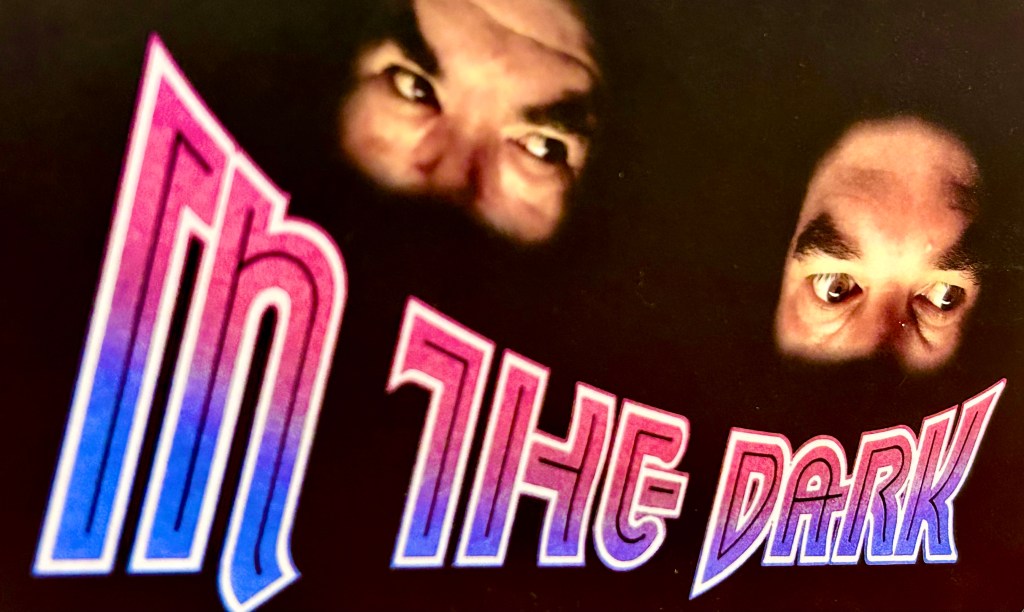
In the Dark Album Artwork – Fair Use


 Digital Wax