
BY DIGITAL WAX MEDIA STAFF
Western culture has evolved substantially over the past century, with popular music as we know it having only truly coming to be defined in recent decades. While artists such as Charlie Parker, Chuck Berry, Michael Jackson, and many others have been invaluable in their influence, two acts have stood above the rest according to Red Hot Chili Peppers bassist, Flea – those being Louis Armstrong and The Beatles.
The bassist, a founding member and key figure in west-coast rock outfit the Red Hot Chili Peppers since the band’s 1982 formation, took to social media over the weekend to offer his two cents on the subject, posting to his account on the X platform.
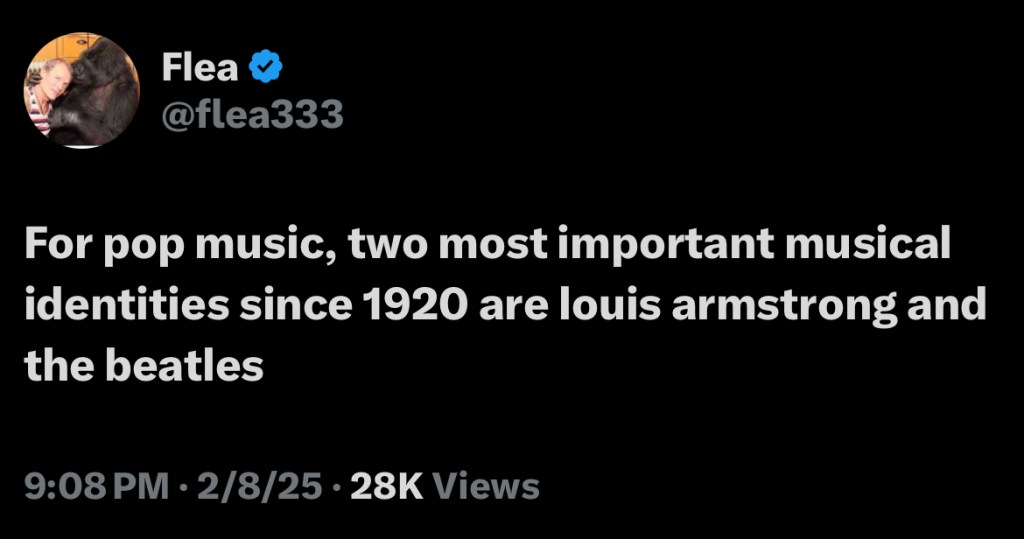
There is certainly a legitimate argument to be made for such a claim, as the two musical juggernauts, while seemingly disparate from one another, share in the notion of each having been singular in their respective and irrevocable impacts on music and culture at large. The two artists even compete with one another as contemporaries, despite Armstrong’s having begun his career in 1918 – a full 42 years prior to the formation of the iconic Liverpudlian quartet.
These overlapping of cultural exports would occur in 1964 at the height of what has come to be known as Beatlemania. The four young mop-top lads had achieved international superstardom and were topping charts the world over. Still, this didn’t stop a 62-year-old Louis Armstrong from knocking the the most popular band in the world from atop the Hot 200 songs chart during his own commercial resurgence with the song “Hello Dolly.” This was additionally notable in that The Beatles had previously occupied the number-one spot for fourteen straight weeks with three separate songs.
But commercial success notwithstanding, the impact of the respective careers of Louis Armstrong and The Beatles played roles unparalleled in the shaping of all that would follow in their wake musically. Of course, similar arguments could be made on behalf of the likes of blues and jazz pioneers Robert Johnson and Jelly Roll Morton – whose earliest recordings date back to 1923 and 1936, respectively. But the significance of the 1920 distinction in the declaration set forth by Flea is unclear.
This wouldn’t be the first of such declarations made by the bassist and trumpet player – himself a noted and devout student of the jazz genre. In March of 2020 the musician would group the acts together, along with jazz vocalist Billie Holiday, as having been, “the vocalists who had a powerful effect on me in my childhood”.
Flea would also assign the interesting distinction to Louis Armstrong and his Hot Five and Hot Seven ensembles as having, “recorded the happiest music of all time.”
The rippling influence of The Beatles is perhaps more prescient in the minds of the general public, as many of the emerging trends in rock music over the past 60 years can be traced directly back to the group. Many ideas which have become regularly utilized tools of the trade were originated, or at the very least popularized by the English hitmakers. These include the use of intentional feedback in recordings, backmasking of tape, and even the advent of the full-length album of original music as a viable means of creative expression.
But in the case of Louis Armstrong, to understand the true significance of the man known as “Pops,” one would first need to comprehend the significance of the jazz genre in American music as a whole. One could write an entire book – and indeed, many have done so – on the importance of jazz as a socio-economic force and paramount culture export of America. But to simplify things dramatically in terms of musical impact, jazz essentially made way for musical as a vehicle of personal expression which could adhere in real time to the most nuanced characteristics of the individual performing it.
While the widely influential classical music of the 1700s and 1800s was predicated on conformity of those performing it to a predefined compositional score, jazz deviated profoundly from expectations. Deriving the improvisational sensibility of very early blues and combining them with some of the more complex and sophisticated elements of European music, the synthesis was established would provided a palette for self-expression and creation limited only by the musical imagination of a performer.
Louis Armstrong would be among the figures to embody these principles, which themselves would serve as the basis for the wild abandon of rock & roll, the expressive individualism of funk and hip-hop, and a litany of additional styles over the ensuing decades. Deviation from expectations was key in Armstrong’s influence, with his improvisational passes on the cornet having eventually invented the concept of the “solo” in popular music. Although the concept almost certainly didn’t originate with Armstrong, much like The Beatles in their many areas of influence, it was Armstrong’s platform which brought the concept to the masses.
While melodic variation in music was not an unheard of concept prior to Armstrong, he would pioneer the concept of re-harmonization in songs through restructurings based on chordal harmonies rather than just melodic deviation. These ideas would open the door for the musically redefining work of musicians like Charlie Parker and Thelonious Monk who would emerge some decades later.
Such improvisation was not limited, however, to Armstrong’s work as an instrumental soloist. The musician would bring this same expressionist and improvisational sensibility to his work as a vocalist. Through his renditions of popular tunes, Armstrong would introduce scat-singing, a form of vocal and lyrical improvisation, to the American popukar music lexicon.
Armstrong’s 1926 record, “Heebie Jeebies” is widely considered to be the first recorded instance of the scat-singing phenomenon. Such contributions would be essential to the later development of improvisational vocal techniques which would become essential to art forms such as hip-hop.
The landscape of popular music is vast and expansive. Given these parameters, along with the highly subjective nature of music interpretation, labels and designations in terms of musical importance are bound to vary endlessly among dedicated listeners and students of the craft. But in considering potential candidates for the two most important musical identities in pop (popular music) over the past 105 years, there are certainly worse possible selections than one-two-punch of jazz and rock/pop revolutionaries Louis Armstrong and The Beatles recently put forth by Flea.
Feature Photo used under the Creative Commons Attribution-Share Alike 4.0 International license.
Post included courtesy of X



 Digital Wax