BY: DIGITAL WAX MEDIA STAFF
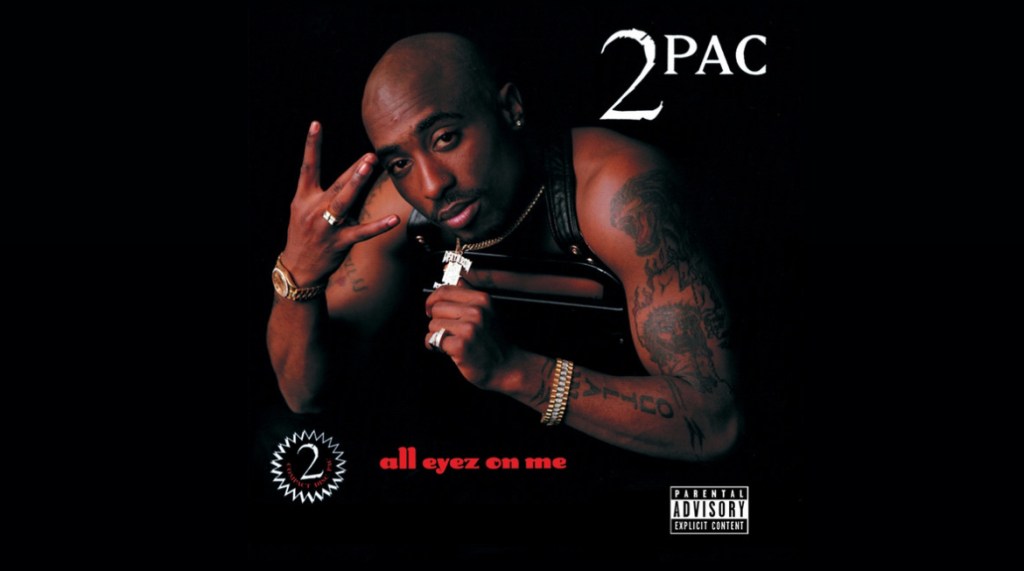
Rapper Tupac Shakur – known professionally as 2Pac – has all but become synonymous with hip-hop as a culture and as a genre. His intensely passionate delivery and sometimes volatile persona brought Shakur to the forefront of the public eye during his short life. The trials and tribulations endured by 2Pac throughout his career seemed to culminate with the 1996 release of All Eyez On Me, a sprawling double album through which the rapper would cement his legacy as one of the greatest of all time.
By the mid-1990s, 2Pac had established himself as one of the foremost figures in hip-hop with Me Against the World. The album, considered by many to be Shakur’s best, saw the rapper present a more introspective artistic statement which also included the type of social commentary characteristic of his previous work up to that point.
“Whatever mistakes I make, I make out of ignorance, not out of disrespect to music or the art,” Shakur is quoted as having said of the album, which he compared to records in the blues genre. “So ‘Me Against the World’ was deep, reflective.”
Contrasting this perspective was the consistent presence of 2Pac in media headlines and in courtrooms in relation to a mounting conglomeration of legal troubles. By the age of 23, Shakur had already become a platinum-selling artist, been in and out of jail, shot two off-duty police officers, been convicted and sent back to jail once more, and been shot five times during an armed robbery. The latter event would later serve as the basis of the infamous feud between 2pac and contemporary The Notorious B.I.G., which is widely believed to have ultimately led to the untimely deaths of both artists.
2Pacwould return to jail but would be bailed out by label executive Suge Knight in exchange for delivering three albums’ worth of material for Knight’s Death Row Records, thus establishing a partnership between the two. Shakur, fresh out of jail and very much full of piss and vinegar – so to speak – got to work straight away, hitting the recording studio and knocking out new material at an astounding rate.
In just over two months following his release from Clinton Correctional Facility, 2pac had completed work on a 27-track gangsta rap masterpiece which would serve to further elevate the subgenre into the mainstream. As such, the project would be a precursor and pioneering document for the subsequent gangsta rap waves of the late 1990s and early 2000s, which would see artists such as Jay-Z, DMX, 50 Cent, and many others achieve widespread commercial success.
The sheer enormity of All Eyez On Me was also notable in that it meant that 2Pac had knocked out 66.6% of his contractual obligation to Death Row Records in just four months upon the album’s release on February 13, 1996. In November of that same year he would complete the obligation, albeit posthumously, with the release of The Don Killuminati: The 7 Day Theory.
The ferocity and speed at which Shakur insisted upon working during the final year of his life has led some to suggest that he was actively attempting to fulfill his contractual obligations to Knight as quickly as possible so as to sever the association. The rapper notably expressed a certain loyalty to and fondness for the Death Row Records label in both footage from 1996 and in lyrics throughout All Eyez On Me.
With All Eyez On Me, Shakur upped the stakes lyrically with regard to his “thug life” persona, embracing all things street and boasting vehemently of the perception of his own dangerous lifestyle. The prevalence of such themes are evident immediately upon pressing “play” on the album, with the dark opener “Ambitionz as a Ridah” – expertly produced by Daz – painting a clear picture of the project’s mission statement.
Production is a significant aspect of All Eyez On Me and, along with a more heavy-handed embrace of the thug lifestyle, is a key variable of what made the album a departure of sorts for Shakur. Minor key production in a similar vein to “Ambitionz” crops up all throughout the record, establishing a sinister atmosphere and rendering Shakur’s incessant foreshadowing of his own demise at an early age all the more haunting in retrospect. Tracks like “No More Pain,” “Tradin’ War Stories,” and “When We Ride” act as examples of the dark instrumentation which permeates certain sections of All Eyes On Me.
The other side of that same coin is All Eyez On Me having served as a cross-section between two hip-hop heavyweights, 2Pac and Dr. Dre – never mind that Snoop Dogg – then Snoop Doggy Dogg – was also very much a significant part of the picture. Despite some purported misgivings presented by Dre – ever the consummate professional – of working with the unpredictable and perpetually-due-in-court Shakur, the pair’s shared time on Death Row did lead to two heavy-hitting collaborative efforts for the two artists.
These came in the form of the “California Love (Remix)” which became an almost instant anthem complete with a dystopian music video featuring both lead rappers. Perhaps it’s the ubiquity of “California Love” as a radio staple for nearly three decades, but for this writer’s money, All Eyez On Me Disc 2 opening number “Can’t C Me” featuring the one and only George Clinton is the pinnacle of the 2Pac/Dre collaborative relationship.
This beat is just gnarly – it’s Dr. Dre dropping the grimiest and funkiest funk of his famed G-funk era. It is perhaps the only beat upon which 2Pac rapped during his lifetime that matched him blow for blow in terms of intensity and ferocity. The intensity and dexterity of Shakur’s flow throughout “Can’t C Me” almost undoubtedly acted as a guiding light of sorts for future megastar Eminem, who project in a similarly unhinged manner during his most acclaimed commercial and critical runs.
2Pac was almost always full of energy in his delivery, but he’s a different beast entirely throughout “Can’t C Me,” and one can tell he’s being charged up by the production itself. It’s also worth suggesting that Pac may have been particularly inspired by the production based on the fact that he goes in for three full verses as opposed to padding verses out with features from his Outlawz cohorts and other regular collaborators. The rapper was notoriously adamant about achieving a workable recording in one take so as to maintain feel of that initial delivery. It’s an impressive approach and one consistent with Shakur’s notoriously fast-paced workflow. While 2pac almost never even seemed to break a sweat in the booth in spite of his intense delivery, there’s a moment in the third verse of “Can’t C Me” wherein the rapper sounds almost overcome with the ferocity of his own delivery and that of the banging beat behind him while delivering the lyrical jab:
”I can make a motherf*cker shake, rattle and roll/ I’m full of liquor thug n*gga quick to jab at them h*es”
While on paper the passage may not exactly look like Shakespeare, that’s part of the magic of 2Pac. Because in hearing it delivered straight from the rapper’s soul, a seemingly unremarkable collection of words can carry genuinely profound implications.
All Eyez On Me also sees 2Pac leading the charge on several notable posse cuts, including aforementioned numbers “Tradin’ War Storiez” featuring C-Bo, Storm, and Dramacycal and “When We Ride” featuring the Outlaw Immortalz. Perhaps of particular note is early Disc 1 cut “God My Mind Made Up” produced by and featuring Daz, along with Kurupt and the legendary Method Man and Redman pairing – the latter two having been notable east coast affiliates at the time of All Eyez On Me’s release.
Two enduring moments from the fourth 2Pac studio album – the penultimate release of his lifetime – are also two of the most restrained. Title track “All Eyez On Me” and “Picture Me Rollin’” – both featuring Thug Life collective member Big Syke – act almost as sister songs to one another, each offering a glimpse into the more introspective side of 2Pac‘s creativity harkening back to the Me Against the World era. What’s more, both tunes feature sparse G-funk reminiscent production by Johnny J, who is at the helm for many of the beats populating All Eyez On Me.
For younger or more modern listeners it may not be immediately apparent how or why All Eyez On Me was such a bold and enduring statement of intent upon its release in 1996. After all, in the current age of streaming, gargantuan projects featuring dozens of songs to encourage inflated streaming stats has all but become the norm. Additionally, talk of guns and violence in one’s bars has similarly become just about as commonplace as saying “you’re the one” in a romantic ballad.
But All Eyez On Me is deceptively remarkable in the same way that one might say Chuck Berry or Little Richard were remarkable when they were quite literally inventing rock & roll. Those licks have become such a part of the cultural lexicon that they’ve become associated with being derivative in the minds of listeners. But this is due simply to the sheer number of instances in which those who followed would copy or reinterpret what, at the time, was very much a revolutionary occurrence.
The same can be said of the audacious and unrelenting sonic experience that is 2Pac’s All Eyez On Me. If it sounds like something you’ve heard before, it’s because essentially everyone who has picked up a mic since its release has internalized and regurgitated something from it. Like Me Against the World before it and The Don Killuminati: The 7 Day Theory afterward, All Eyez On Me was essential in defining hip-hop as we know it to day and in cementing the legacy of 2Pac as one of the greatest rappers of all time.
All Eyez On Me Album Artwork – Fair Use


 Digital Wax