BY: DIGITAL WAX MEDIA STAFF
Ginger Baker has long been regarded as one of the most impactful and revered musicians in the classic rocklexicon. The early years of Baker’s career playing alongside fellow icons Jack Bruce and Eric Clapton as part of blues rock heavyweight ensemble Cream were enough to establish the drummer as one of the most influential musicians of his time.
Though Cream would originally remain active for four albums released over a two-year period, Baker would continue working steadily, regrouping with Clapton for the even shorter-lived supergroup Blind Faith with Steve Winwood, and Ric Grech.
Despite not quite managing to attain the success of his early projects, Baker would go on to perform in various capacities over ensuing decades. This included time leading the Ginger Baker’s Air Force fusion ensemble, and performing with Hawkwind, BBM, Masters of Reality, and other units.
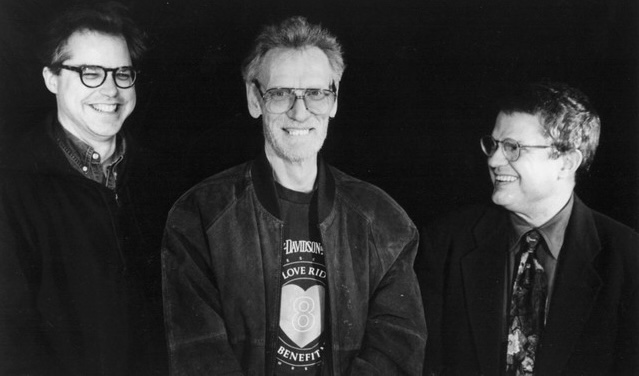
An oft-forgotten musical excursion of Baker’s though came in the 1990s, when the drummer recruited guitarist Bill Frisell and bassist Charlie Haden to perform his very own instrumental jazz group: the Ginger Baker Trio.
With a session background and credits playing alongside the likes of Paul Motian, Jim Hall, Lee Konitz, and countless others, Frisell has etched out a notable reputation in the world of jazz, and has gained notoriety for his work in the folk, country, rock, and Americana genres as well.
Bassist Charlie Haden was a key figure in the redefinition of what was harmonically possible within the parameters of jazz music, and indeed, in music in general. Haden’s improvisational collaborations with saxophonist Ornette Coleman – which would come to be known as “free jazz” – changed the perception of what was acceptable and even feasible with regard to the role of bass in music and with regard to collaborative performance and composition.
Haden would lead many ensembles of his own and collaborate with an array of notable musicians throughout his extensive career. In 1994, he would bring his distinctively exploratory low-end sensibilities to the newly formed Ginger Baker Trio.
The musicians’ debut project as a trio, Going Back Home, saw release in 1994 and primarily comprised original material, though two standard numbers – Thelonious Monk’s “Straight No Chaser” and Ornette Coleman’s “Ramblin’”, respectively – would see inclusion as well.
The remaining ten tracks would each have their origins with one of the group’s core members, with Bill Frisell having been credited for the writing of two of the record’s tunes, Haden with three, and Baker himself with three.
Going Back Home opens with Frisell’s “Rambler”, introducing the album with a stuttering drum beat from the leader of the trio. The tune itself is melodically driven by laid back, almost Carribean-sounding electric guitar lines from Frisell.
The engineering and production throughout Going Back Home is certainly of note, particularly given the prominence of Baker’s drums as a driving force for the project. Baker’s background in jazz predates even his time as a member of Cream, but one could certainly argue that the drumming throughout was informed to an extent by rock drumming.
Despite the ferocity and resounding attack commonly associated with Baker’s playing, the drums throughout the album retain a decidedly jazzy feel, never overtaking the surrounding instrumentation or driving the proceedings away from a general jazz ensemble atmosphere.
This is likely at least in part due to the nuance and technique of Baker’s playing, but one would be remiss not to consider the engineering and production savvy at play here with regard to maintaining a balanced set of sonics throughout these numbers.
The trio’s take on “Straight No Chaser” – the album’s lone composition by musical genius Thelonious Monk – finds Charlie Haden taking an honest-to-god bass solo as the guitar takes a respite. Baker’s drumming is engaging throughout as the musician brings out unpredictable fill after unpredictable fill while maintaining the structural integrity of the piece.
Baker can be heard getting particularly jazzy for Ornette Coleman’s “Ramblin’”, which the drummer opens with a swinging ride cymbal intro, which gives way to atmospheric, ringing chords, and blues-influenced lead lines from Frisell. Haden stays busy on the low end, adding complementary harmonics and providing inventive rhythmic context to Baker’s already expansive contributions on drums.
The mid -point of “Ramblin’” is once instance in which Going Back Home approaches legitimate rock territory, with wild guitar squeals and pounding drum rolls driving the tune forward for a time.
The Latin-tinged “Ain Temouchant” provides a pleasant rhythm which serves as the foundation for hypnotic arpeggios from Frisell. Later in the album, for the appropriately titled “Spiritual,” Frisell is highly economical in his contributions, laying back for a great deal of the passages, allowing for Haden to truly be heard in what is also an impressively economic performance from the bass legend.
“When We Go” brings a triplet feel to the record, the propulsion of the tune leaning significantly in on rolling tom patterns by baker. The elasticity of Haden’s creative upright bass work ties everything together as Frisell provides bright, country-infused flourishes on top.
The trio really stretches out for “In the Moment,” a tune which perhaps received its designation due to the improvisatory nature of its recording/composition. The tune is the closest approximation of Haden’s explosively unrestrained work with Ornette Coleman to be found throughout Going Back Home, with unpredictable rhythmic turns and modal variation perpetuating the sense of excitement permeating the tune.
Near the end of “In the Moment,” listeners are treated to one of Ginger Baker’s trademark virtuosic drum solos. The passage brings the tune to its final moments as the accompanying musicians re-enter the fray to bring the exercise to its conclusion.
The Ginger Baker Trio would not simply serve as a one-off project, however. Baker would regroup with Haden and Frisell twice more to continue their work – once in 1996 for Falling of the Roof, essentially a sister album to and stylistic continuation of its predecessor, and again for 1999’s Coward of the Country.
While billed as an album from the Ginger Baker Trio, Coward of the Country features a dense personnel lineup which includes the Denver Jazz Quintet-to-Octet and jazz clarinetist and saxophonist James Carter. The result is an engaging, if more fusion-centric work which, while effective, feels fairly removed from the more minimalist approach of the trio’s first efforts.
The status of Ginger Baker as one of the foremost contributors to the popular music lexicon ceased to be a matter of debate some decades ago. Though in spite of his more obvious accomplishments as a rock musician, Baker’s time as a contributing musician and bandleader in the complex world of jazz as the leader of the Ginger Baker Trio is more than warranting of recognition.
The musical legacy of one of popular music’s most well known players is perhaps as complex as was the man himself. But given Ginger Baker’s deep-running roots in the jazz sphere, his work in leading the Ginger Baker Trio endures for posterity, concretely expanding the artistic narrative and creative appreciation associated with a true forebear of drumming in popular music.
Photo: Ginger Baker Trio – Going Back Home Promotional Materials, Fair Use
Connect with Digital Wax on Facebook, X, Instagram, Threads, and Bluesky.


 Digital Wax