BY: DIGITAL WAX MEDIA STAFF
On May 8th, 1977, the Grateful Dead performed what would become one of the most highly acclaimed and immediately recognizable shows of their decades-long career, taking the stage at Cornell University’s Barton Hall.
Having since become a staple of the band’s recorded history as well as having been included in the National Recording Registry of the Library of Congress for cultural, historic, or aesthetic significance, and/or informing or reflecting life in the United States, the 5/8/77 show is widely considered to be among the best of the band’s career. The Grateful Dead are known almost exclusively for their live performances, as each show presents a unique take on the group’s expansive catalog and would bring different facets of the members’ respective skill sets and abilities to the forefront each night.
The Barton Hall set saw the stars align, as it were. The set not only featured a remarkable performance from the band itself, but the live recording of the night’s events was impeccable, rivaling much of the polished and touched-up studio material actively being released by contemporaries of the band at the time.
The characteristically lengthy setlist included plenty of live-staples and fan-favorites such as “Morning Dew,” which was being played with less regularity at this point in the Grateful Dead’s career. “Scarlet Begonias” into “Fire on the Mountain” made for a particularly memorable “Scarlet/Fire” on this eventing and a band take on a Jerry Garcia solo tune “Loser,” which by this time had long been fully incorporated as part of the Dead’s setlists, was given a particularly exhilarating treatment by the enigmatic musician. An emotional runthrough of the minor-key number was capped off by a scorching, pinch harmonic-infused guitar solo by Garcia, who seemed to endow each passing note with a deeply rooted sense of sorrow and frustration.
The final stretch of tunes from the performance served as a throwback of sorts to the late-60s peak of the band’s “primal dead” era, with early favorites like “St. Stephen,” career staple “Not Fade Away,” and the aforementioned “Morning Dew” being dusted off to close out the memorable show. Additionally, the inclusion of several Weir “cowboy” tunes in the country vein such as “El Paso” and “Mama Tried,” along with his original material like “Lazy Lightning” and “Supplication” that would heavily inform the band’s sets into the 1980s sees the Barton Hall concert offering a decidedly rounded perspective of much of the band’s career up to that point.
Inner-band issues weren’t terribly conspicuous on this night or event at this juncture in the band’s career, but trouble was brewing just beneath the surface. The late-70s would bring about the beginnings of singer/guitarist Jerry Garcia’s well-documented health struggles which would eventually lead to his passing in August of 1995. The band’s keyboardist for the show Keith Godchaux, who joined the band in 1971, was approaching an even earlier demise, and would ultimately pass away just three years after the show.
1977 would be a “final hurrah” of sorts for Godchaux as the Grateful Dead’s keyboardist, as it would be the final year his playing style would not be met with active criticism from members of the band and the listening public – retroactively or otherwise. Nonetheless, while consistent if more static than in previous years, 1977 came off the heels of a spectacular 1976 for Keith Godchaux, whose delicate touch would be pivotal to the dynamics of some underappreciated Dead performances as well as shows with the Jerry Garcia Band which would put his abilities on full display.
But though such issues were decidedly close to reaching a fever pitch on May 8th, 1977, the bubble had yet to burst. In fact, for all intents and purposes, the Dead were, according to some, at the top of their game on this very night. Though opinions vary greatly among devoted fans, the general consensus dictates the band’s 1972 European tour and 1977 Barton Hall performance as being two definitive musical peaks for the band.
The Dead’s 1977 performance at Barton Hall has taken on such a mythology that many fans have taken to issuing critiques of the show in light of the immense attention it has garnered over the years for its sheer quality. 1977 as a whole is widely considered to be one of the most consistent years for the band, with the Spring of ‘77 having been especially embraced. As such, many will point to neighboring shows such as the May 7, 1977 performance in Boston – a birthday show for drummer Bill Kreautzmann – as well as May 9, 1977 in New York as having been of equivalent or even superior quality to their May 8, 1977 counterpart.
Both Godchaux and his wife, backing vocalist Donna Jean, would depart the band in 1979 amidst various issues both personal and professional. This would give way for an entirely new period for the band complete with changes in personnel, musical direction, performance dynamic, and more.
Nonetheless, the May 8th, 1977 performance at Cornell University’s Barton Hall stands still today as a high watermark for a band whose unique approach to live performance served as the catalyst for a musical and cultural movement which remains ongoing in the present. The live recordings taken from the show were released on May 5, 2017, in remastered form for Record Store Day.
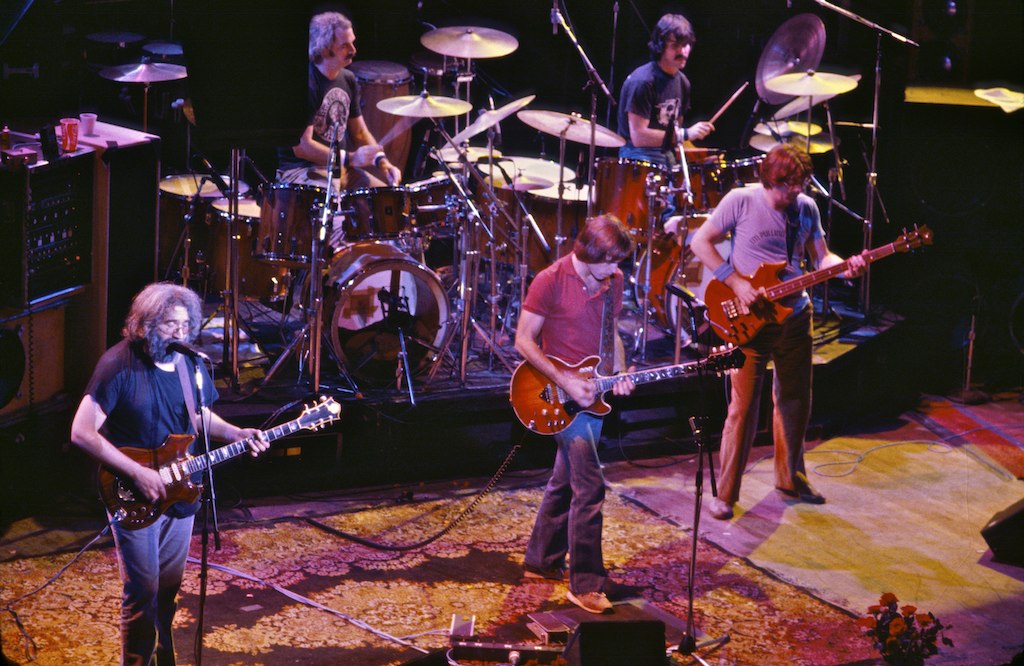
Photo: Grateful Dead at the Warfield Theatre – San Francisco, October 9, 1980 – by Chris Stone with Grateful Photo used under the Creative Commons Attribution-Share Alike 2.0 Generic license

 Digital Wax