BY: DIGITAL WAX MEDIA STAFF
It might be a tough sell to convince your standard rock fan that a track from what is arguably the most highly regarded album from a band widely considered to be the best in the business is underrated in any sense, but hear us out.
Since their heyday, the Rolling Stones have built an enormously successful brand on their billing as “the greatest rock and roll band in the world.” The band’s grimy 1972 masterpiece Exile on Main St. has served as a significant feather in the band’s cap, and has been a real qualifier for anyone doubting their status as the best to do it.
The album is peculiar in the band’s discography for a number of reasons, not the least of which is the critical lambasting it received upon release, only for it to later be hailed as a peak achievement in popular music and in rock and roll specifically. In any case, Exile was never a top earner for the Stones as far as commercial prospects are concerned, coming in between 1980’s Emotional Rescue and 1973’s Goat’s Head Soup, both of which were tepidly received upon release.
Furthermore, Exile was all but devoid of what one might consider smash singles. Lead single “Tumbling Dice” has become a fan-favorite, and its follow-up, the Keith Richards calling card, “Happy” is likewise beloved among the band’s core fan-base. Commendable success aside, these tracks don’t boast the instant global recognizability of an “(I Can’t Get No) Satisfaction” or a “Honky Tonk Women” – both number one hits.
To compound the matter further still, Exile on Main St. was released as a double LP. An unapologetic 67 minutes of dirty blues recorded in a basement with a decisively muddy mix proved tough for the listening public to swallow in the early ‘70s, but folks have since come around to recognizing its brilliance in more recent decades.
Wedged in the middle of Side 3 of the record is a track credited to Jagger-Richards and then-newbie lead guitarist Mick Taylor – one of only two writing credits Taylor would receive with the band. The tune is “Ventilator Blues,” and it essentially functions as the bridge between Mick and Keith’s very early discovery of American blues and the identity the band was in the process of forging for itself.
Constructed around a looping Mick Taylor riff in G minor – harkening back to the influence of Chicago blues legend Hubert Sumlin – there is a casual sort of menace to “Ventilator Blues.” Imagery of screaming, violence, firearms, and murder permeates the lyric as the band do what they do best, accompanied by go-to sidemen Bobby Keys (saxophone), Jim Price (trumpet), and Nicky Hopkins (piano).
From the moment the riff opens things up, the listener begins experiencing the auditory equivalent of being cramped up in a musty room in some questionable predicament. This sensation only intensifies as additional instrumentation is brought in, creating a sonic atmosphere that, by the end of track’s concise 3-minute and 24-second runtime, makes it feel a little difficult to breathe.
Bobby Keys’ subtle saxophone work plays a key role in this dynamic, and the tune is one of many standout moments for the Texan throughout Exile on Main St. He has also been credited by drummer Charlie Watts as having established the rhythmic pocket of the tune, as the number initially was one which Watts couldn’t quite find the time – an odd but recurring scenario for the Stones – (“You Can’t Always Get What You Want” was a similarly perplexing session for the legendary drummer.)
Given the tune’s distinctive pocket, it isn’t one that has been played all that often during the band’s gargantuan run as a live commodity. In fact, the track apparently has only been performed live once, just after the band set on the road in promotion of Exile in 1972 for the North American leg of the tour.
Watts has stated, however, that the band would frequently rehearse “Ventilator Blues” but that they never could seem to get close to the original performance that landed on Exile on Main St. Thankfully, the album version will always exist in all its muddy, gritty glory for posterity.
Despite Watts’ initial troubles nailing down the song’s beat – it is said he ultimately played along to the clapping of Bobby Keys, who stood beside him during the recording – the drummer turned out a fine performance for the track, laying down a deceptively simplistic beat chocked full of Watts’ signature delayed snare shots that create a dynamic push-and-pull effect. This technique would be also be heard on “Tumbling Dice” and again on tracks like “Beast of Burden” among countless others.
Vocally, “Ventilator Blues” finds Jagger channeling the pioneering bluesmen of old, though in this instance it’s more of a Howlin’ Wolf-adjacent growl than the typical southern caricature one would hear in tunes such as “Dead Flowers” and “Far Away Eyes.” While he is generally regarded as one of the greatest rock and roll frontmen of all time, Mick Jagger’s vocal range isn’t typically the subject of all that much praise.
It’s a vastly difficult characteristic of the Stones’ sound to replicate, however. This is one reason you don’t typically hear a ton of material from the Rolling Stones’ catalogue being replicated night after night by your average bar band – that and the fact that most guitarists can’t be arsed to internalize open-G tuning.
On the surface, many of Mick Jagger’s vocal contributions can come off as talky or shouty, betraying the technique and breath control that go into their delivery. Despite his having constructed his whole approach as an imitation/interpretation of his influences, Jagger is singular in his approach as a vocalist.
”Ventilator Blues” serves as a great example of this deceptive diversity in practice. One has to really get in the weeds of conjuring the grit to replicate the verse sections – this, while being sure to adhere to the agile rhythmic pocket of the delivery. Moving into the chorus, the instrumentation seems to melt into the next section, with Mick vocal increasing in aggression alongside the band before he briefly soars off to some legitimately impressive notes.
More so interesting than any particular characteristic of the vocal, however, is the juggling act that is presenting all these elements in a balanced manner while maintaining the key and rhythm of the music – never mind launching into full sprints back and forth across a stage for hours a time while it’s all happening.
At its core, “Ventilator Blues” could be said to be representative of the Rolling Stones that crafted the band’s defining album – a Rolling Stones that would never truly be seen or heard from again in earnest after 1972. No matter how immense the stages get, we’ll always have tracks like “Ventilator Blues” to remind of us the pure essence of the Stones conjured by the band itself that summer in the basement.
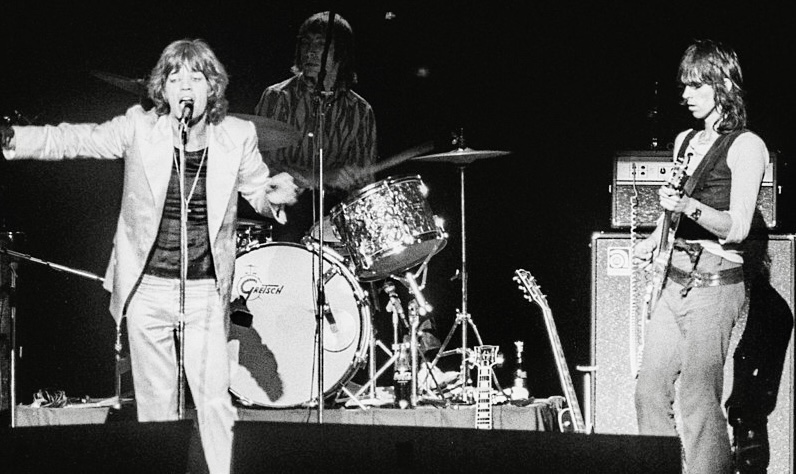
Photo: The Rolling Stones performing at Helsinki Olympic Stadium by Kari Pulkkinen – Public Domain
Connect with Digital Wax on Facebook, X, Instagram, Threads, and Bluesky.




 Digital Wax