BY: DIGITAL WAX MEDIA STAFF
Charlie Sheen is perhaps most remembered today for the drug-fueled media spectacle of which he would become the ringleader at the height of his TV stardom. Once he hit his tiger blood arc, much of the goodwill he’d established prior as a serious performer was all but decimated seemingly overnight. But behind the tabloid antics, juvenile comedy roles, and general noise is an actor that demonstrated a notable level of skill at points.
Some movie buffs will concede that Sheen’s early film work showed a performer with a lot of promise, and rightfully so. One of Sheen’s most frequently cited performances was for the 1986 year 1986 year wartime drama, Platoon. Here, he shows a measured restraint that acts as an anchor to the chaotic Vietnam conflict portrait being dictated by director Oliver Stone. As Private Chris Taylor, Sheen showed a groundedness and minimalistic approach that would be a far cry from the demeanor for which he would become known later in life.
Sheen would take on more complexity the following year with Wall Street, another Oliver Stone vehicle. Holding his own acting alongside his own father Martin Sheen and a particularly rare-form performance from Michael Douglas, Sheen would further establish the subtle nuance for which he was once known on-screen.
Near the turn of the decade Sheen would begin utilizing his straight-man energy to great effect in comedies like Major League and Hot Shots! This sort of anti-comedy approach, rooted in an “is he actual serious?” seriousness would eventually make him the highest-paid comedic actor on television.
He would continue to work consistently through the ‘90s and early 2000s, and in 2003 would move into the role for which he would become most well known. Chuck Lorre’s Two and a Half Men would see the actor cast as an exaggerated version of himself, a role in which he would thrive. It may be easy for some to characterize the role as fish-in-a-barrel for the actor, but one would be remiss to underestimate the subtlety of craft it takes to land an allegorical plane of this nature without losing all value inherent within the subject matter.
Subtly is a surprisingly common element of Sheen’s work. Even at its most boisterous and obnoxious, his acting style is rooted in a sort of subtle humanity that permeates everything he does. In the case of Two and a Half Men, it’s all about timing, and the comedic timing of Charlie Sheen was the anchor of that show. There is something to be said about taking on a character written to be so unquestionably unlikable – more and more so with each passing season, as a matter of fact – and still managing not only to make it work, but to make a large portion of the audience root for the unlikable bastard regardless.
Following the media blitzkrieg that Sheen himself would initiate in 2011, he would remain in telecom work for a few years before more or less going quite professionally. The cultural moment was so immense that it all but whitewashed the memory of Sheen’s more tasteful early work from the collective consciousness. Still, it isn’t too difficult to imagine a reality in which Sheen stayed the course pursuing worthwhile film work.
It isn’t all that farfetched to envision him having carved out a path for himself similar to that of a Sean Penn or Eric Roberts. After all, the man secured a Golden Globe Award and a star on the Hollywood Walk of Fame, along with a Screen Actors Guild Award nomination before even landing his most famous role.
Charlie Sheen’s career has been nothing if not interesting. He’s established himself as a professional success at one point or another by most any definition of the term. Love him or hate him, at the end of the day, Charlie Sheen set himself up as one of the most memorable names of his generation, and perhaps that’s enough.
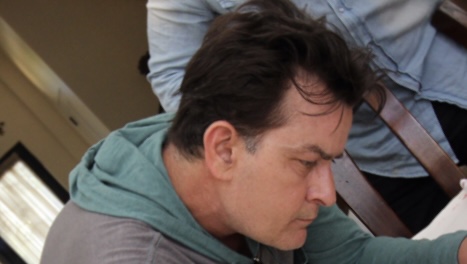
Photo: CS with LT by DeanoJD used under the Creative Commons Attribution-Share Alike 4.0 International license.



 Digital Wax