BY: DIGITAL WAX MEDIA STAFF
When the casual music fan thinks of the Grateful Dead, Bill Kreutzmann and Mickey Hart may not be the first names that come to mind. Many will picture in their mind’s eye the immortalized image of a bearded and bespectacled, fuzzy haired Jerry Garcia playfully gliding through the cosmos on stage for the band’s Europe 72 tour. Some may envision a grizzled and grayed, yet invigorated Garcia reluctantly staging an unexpected takeover of late-80s stadium rock.
Some may explore thoughts of stealies, dancing bears, and other now-iconic imagery made larger than life by the uncharacteristically capitalistic money-machine the Grateful Dead brand would become, and some may even catch flashes of a seemingly cantankerous, Santa Claus-esque Bob Weir sharing the stage with John Mayer, the latter often appearing to be on the precipice of some sort of physical climax as he breathes new life into one of the most beloved and unique catalogs in the world of music.
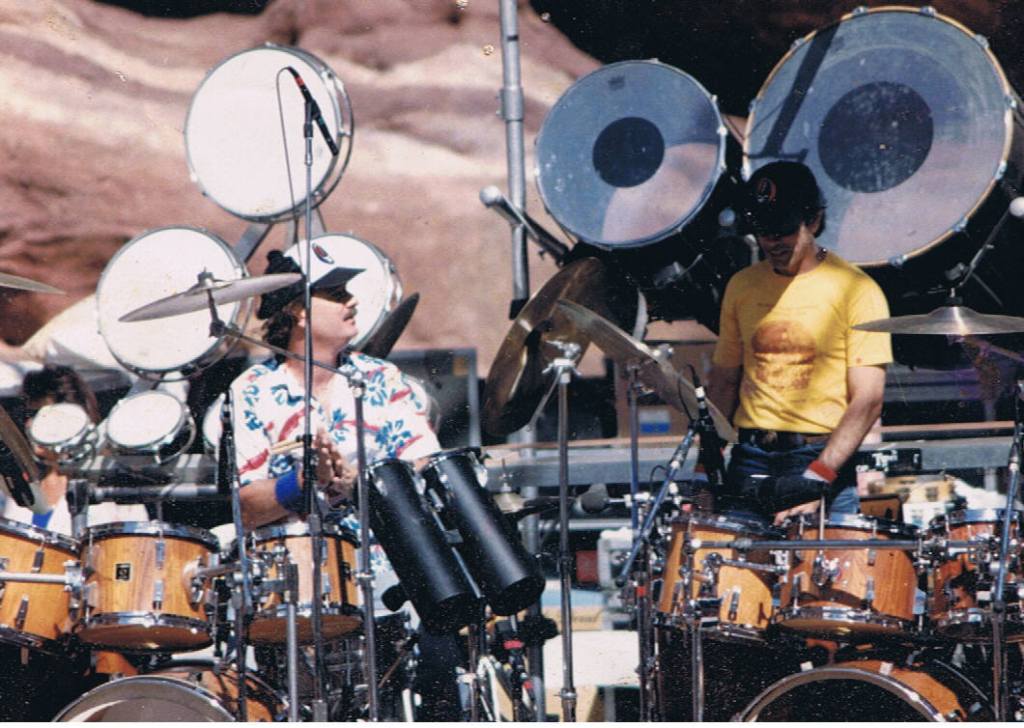
Yet the casual fan is likely to neglect drummers Kreutzmann and Hart – oft referred to by their collective alias, The Rhythm Devils. This, of course, is nothing new. Foundational musicians such as drummers and bassists often get the short end of the Vic Firth in terms of crowd recognition, and sharing a band with a generational force such as Jerry Garcia does little to help matters in the regard.
Yes, to the casual fan, the Grateful Dead may very well be Jerry Garcia and a bunch of guys, or even just a cool logo on a t-shirt. Fortunately, the Grateful Dead weren’t designed with the casual fan in mind. In fact, the Grateful Dead weren’t designed with much of anything in mind. The only real identity which could be assigned to the band is one chosen by default by way of the group’s near-perpetual ambivalence to anything and everything.
Indeed, the Dead were a unit disinclined to embrace much in the way of labels or identifying precisely what it was they were. One thing they were though, according to Mickey Hart, was in the transportation business. Moreover, the musicians comprising the group were in the business of transporting minds – a notion around which Hart would construct his entire existence.
A man intent on altering perspectives and bridging pathways between dimensions, Hart’s modus operandi has always been a tightrope walk between things most human beings would never even consider and the most fundamental aspects of being that join us all in a singular, universal harmony.
Kreutzmann, the founding drummer of the Grateful Dead, has always been the yin to Hart’s yang – or vice versa, take your pick. The booze-addled, roughneck, cocaine cowboy of the group, Billy was just as if not more content hanging with the Dead’s rowdy crew as he was spending time with his fellow musicians. Kreutzmann‘s always seemed a more subtle, yet not necessarily any less potent, spiritual consciousness, while Hart has always come across as clearly and indisputably out-there to all who encounter him.
The two would become fast friends upon meeting in the late-1960s, leading to Kreutzmann’s insistence upon bringing Mickey into the fold as a second drummer – at the time, a decidedly unconventional move for any band. Over the next few years the two would do some of their most compelling work as a duo backing the Dead, laying down odd, layered time signatures criss-crossing over the psychedelic zaniness that would come to define the band’s Primal Dead era.
Hart would take an extended sabbatical just as the band were beginning to achieve legitimate commercial success, leaving Billy to take the reigns as the band’s sole drummer for its highly lauded and exceptionally dynamic 1973-1974 period – an iteration of the group to which bassist Phil Lesh would refer as the, “turbo-charged, turn-on-a-dime Grateful Dead.”
The moniker was apt, as shedding the shell of an entire drummer allowed for the exertion of much less effort for the band in keeping the train on the tracks, as it were. Specifically, Kreutzmann had gained the freedom to get much more liberal with wild fills and unexpected time signature changes without the proceedings devolving to shoes-in-a-drier through the absurd power of a mile-high wall of speakers.
Hart would eventually make his way back into the fold on a full-time basis by 1975, much to the initial consternation of the man responsible for his having become a member in the first place. Though Billy was at first reluctant to relinquish his role as the band’s singular percussive force, he would eventually warm to the idea of Hart’s reinstatement. The two would go on to lead, on a nightly basis, a hallmark of the Grateful Dead’s ever-expanding live experience, Drums: an expressive and life-affirming cosmic experience during which audience members transcend the physical realm and mingle with forces beyond our comprehension through the fluid and vibrational vehicle that is is rhythm – or an excuse to run to the bathroom while Jerry smokes cigarettes behind the curtain, depending on who you ask.
Nonetheless, the Grateful Dead is as much about personalities as it is about music, and Mickey’s cosmic weirdness just gels so exquisitely with everything the band represents that it’d feel criminal for him not to be presented in the lineup – though the Hart-less years undeniably made for some of the most dynamic and satisfying performances of the Dead’s decades-long run.
But that isn’t to say that Hart’s involvement amounts merely to spiritual platitudes and tambourine slaps. Some of the most interesting contributions, both compositionally and performative, for top-shelf material like “Terrapin Station” and “the “Help/Slip/Franklin’s” sequence emerged from the mind of Hart. But if the brief absence of Hart was beneficial in any way it was in allowing for Bill Kreutzmann to demonstrate just what a beastly drummer he happened to be and just how significant he was to the dynamic of the Dead.
One might argue that the Grateful Dead never quite achieved its full potential with regard to what was possible through the band’s especially unique drum situation. But if the Dead ever came close to broaching these possibilities it was in some of the band’s earlier performances and recordings featuring two drummers, where the rhythm devils explored the possibilities of layering disparate time signatures atop one another to have them emerge on simultaneous beats several measures down the line.
One might suggest that the dynamic of the rhythm devils post-1975 was moreso akin to the guitar dynamic or a Weir/Garcia than to a Dave Murray/Adrian Smith. This is to say that, much of what Hart would add to the songs was more of an injecting of color than a compounding or countering of what was being played by Billy.
Of course Hart has always been cited as an endless well of creativity by those who have worked with him, so it would be remiss not to acknowledge how much Mickey is likely to have added in the idea department as much of the music constituting the Grateful Dead discography was being worked out in the studio or on the stage.
It isn’t a dynamic to which everyone takes immediately – that being the later-era double-drummer dynamic. Mixing two full drum kits in conjunction with an already sprawling ensemble of busy musicians is no small feat, and much of the highly compressed punch and “crisp” feel that permeates much of the contemporary musical landscape is lost in this process.
For those willing to brave this sort of unknown terrain, there is much to appreciate beyond the initially off-putting and occasionally perplexing surface – a running theme with regard to the musical equivalent to licorice.
There’s a roundness to the Hart/Kreutzmann system of pounding out accents that, while not necessarily crystal-clear in presentation – offers a resounding foundation befitting of the rolling cosmic community that is the Grateful Dead. The melding together of sounds – attributable in part to a lack of possibility for divisive sonic separation in the mixing stage – gives live proceedings a tribal feel, reflecting both Hart and Kreutzmann‘a respective interests in world music as well as the communal and, dare we say, primitive nature of exactly what it is the Dead was going for as a collective.
To Kreutzmann’s credit, some listeners may posit that he got the short end of the drumstick upon Hart’s return to the fold – a development to which Kreutzmann himself has admitted was initially a source of great frustration.
Kreutzmann also dutifully took the reins as the Dead’s sole drummer upon Mickey’s departure, bringing a certain steadiness to what prior had been – speaking both musically and personally – a house of cards. Having overseen a dynamic restructuring of the group so as to accommodate Hart’s personal situation at the time of his departure, one can understand Billy’s frustrations at all those changes having been seemingly negated at the drop of a hat once Hart made a surprise drop-in at a 1974 gig and never really left again.
Thankfully, all such issues seem to have adequately addressed in short order and the band – again compounded by Hart – would embark upon one of the last truly expansive musical evolutions the Dead would undergo for the band’s 1975-1976 period.
While debatably less consistent than the premier 1977 that would follow, this era saw the band churning out some legitimate ambitious material – Help/Slip/Frank may be as close to prog as the band would ever come. This period would also be driven in part by Hart’s experimentations live and in the studio, including the use of live crickets as a musical instrument.
The dynamic between the drums over ensuing decades would be an interesting one to say the least. Billy has been documented as being opposed to the characterization of “time keeper,” indicating his view of the term as something more befitting of a march drummer. Nonetheless, Kreutzmann is generally considered the anchor of the Dead rhythmically, as Hart’s perception of the role of drums is so far removed from standard convention that the notion of him functioning as the primary timekeeper in any non-percussion ensemble is borderline silly.
The coalescence of the respective approaches makes for quite the distinct sound, albeit one that has been known to veer off the rails from time to time. The looseness of the Rhythm Devils could produce an effect that Jerry Garcia once likened to the sound of “shoes in the dryer,” particularly throughout the 80s. Speaking of the 80s, the prevalence of cocaine in the Grateful Dead circle during the decade is said to have been such that tempos were often rushed to agonizing proportions, much to the chagrin of one Bobby Weir.
Still, the concept of the Grateful Dead has always been much more about taking the leap and potentially crumpling into a heap after misjudging said leap than about rhythmic or sonic perfection. As such, most any Dead aficionado would gladly take “shoes in the dryer” over gridlocked rhythms and perfect pitch.
Mickey’s contributions, particularly during his second stint with the group, was often more about playing over and coloring Bill’s playing than about providing counterpoint or standing out. Perhaps that comes in the form of a rack tom landing in conjunction with Bill’s snare on every beat, which isn’t necessarily helpful as far as ensuring the drums cut through the mix. But again, such trivialities were never at the forefront of the Dead’s awareness as much as was the urgency to put forth something unconventional and in service of all members involved.
That isn’t to say however that Mickey would shift into a role more akin to a traditional percussion accompanist from time to time. I was always a pleasure to hear Hart break out the cowbell embellishments in later years for tunes like “Let It Grow,” and especially for the outro/transition section from “Scarlet Begonias” into “Fire on the Mountain.”
Photo: Grateful Dead drummers Bill Kreutzmann and Mickey Hart by Marcia Wright under the Creative Commons Attribution-Share Alike 3.0 Unported license
Connect with Digital Wax on Facebook, X, Instagram, Threads, and Bluesky.


 Digital Wax